Physician-led neuromodulation education
Understand spinal cord stimulation before anyone tries to sell you a device.
Ten manufacturers make FDA-approved neuromodulation systems, and each will tell you theirs is different. They are right — but the differences that matter are rarely the ones in the brochure. This site explains the therapy, the anatomy, the waveforms and the evidence, so the conversation about your care starts from understanding.
Stimulation waveforms
10
FDA-approved platforms
7 days
Typical trial period
0
Nerves cut or destroyed
What This Site Is
An education resource for understanding your options
Neuromodulation is one of the few areas of medicine where a patient can test the treatment before committing to it. It is also an area where the information available online is dominated by device marketing, which tends to explain what a system is called rather than what it does.
Everything here is written to close that gap. Each chapter covers one subject properly — what it is, how it works, what the published evidence shows, and what the honest trade-offs are. Ten manufacturers are represented, each on its own terms.
This is education, not medical advice. Nothing here substitutes for an evaluation with a physician who has reviewed your history, your imaging and your goals.
The Therapies
Four distinct approaches, often confused with one another
These are not variations on a theme. They target different structures, carry different indications, and suit different patients.
The core therapy
Spinal Cord Stimulation
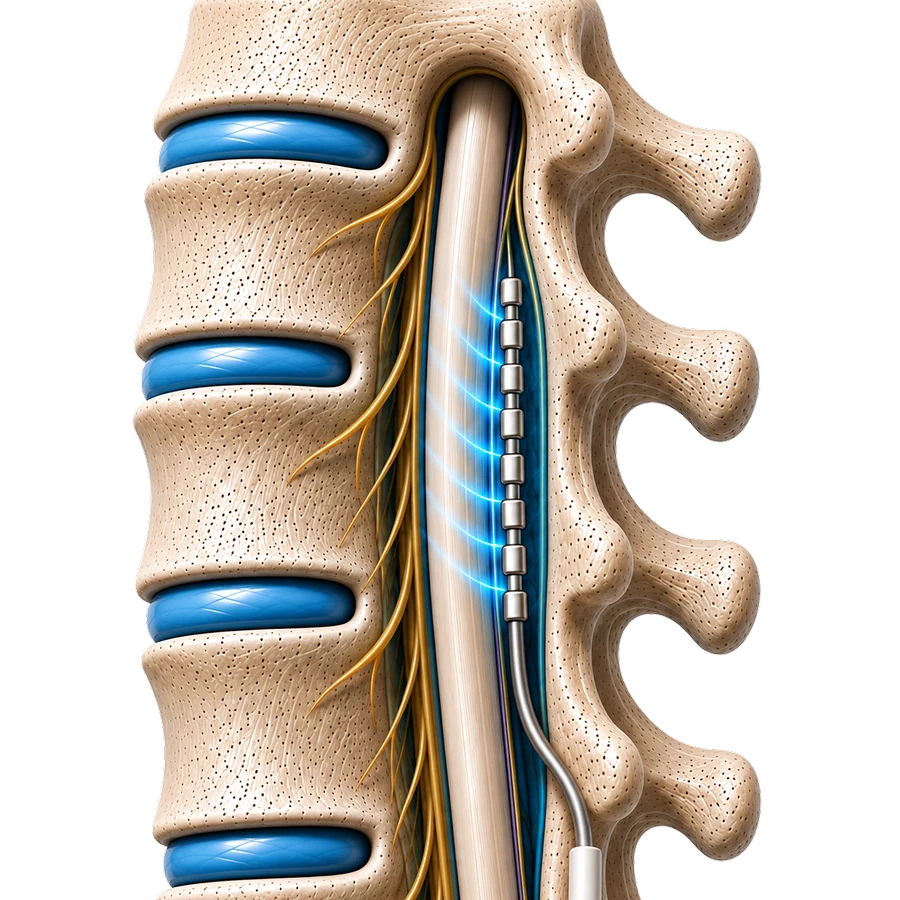
Electrodes placed in the epidural space modulate how pain signals are processed before they reach the brain. Nothing is cut, and you trial it before you commit to it.
Read the chapterFor focal pain
DRG Stimulation
Targets a single dorsal root ganglion instead of the spinal cord, reaching territories like the foot and groin that conventional stimulation covers poorly.
Read the chapterOne nerve at a time
Peripheral Nerve Stimulation
Treats a specific named nerve directly. One form runs for sixty days and is then removed entirely — the lowest-commitment option in the field.
Read the chapterA different goal
Restorative Neurostimulation
ReActiv8 activates the nerve supply to the lumbar multifidus, with the goal of facilitating recovery of neuromuscular control rather than stimulating the spinal cord's dorsal columns.
Read the chapter
The Technologies
All ten FDA-approved platforms, covered individually
Every manufacturer covered here has its own chapter — the signature technology, the systems in the family, the published evidence and the trade-offs.
 neuromodulation.abbott
Abbott Neuromodulation
Spinal cord stimulation · DRG stimulation
SCSDRGBurstDR stimulation, and one of the two dorsal root ganglion platforms in the U.S.
- Proclaim PlusRecharge-free SCS
- Proclaim XRRecharge-free SCS
- EternaRechargeable SCS
 bostonscientific.com
Boston Scientific Neuromodulation
Spinal cord stimulation · Peripheral nerve stimulation
SCSPNSMultiple waveforms in one device, including fast-acting sub-perception therapy.
- WaveWriter AlphaSCS — rechargeable and primary cell
- Spectra WaveWriterSCS — rechargeable
- Nalu SystemPNS — battery-free micro-IPG
 medtronic.com
Medtronic
Spinal cord stimulation
SCSClosed-loopClosed-loop sensing with conditional full-body MRI access, plus the DTM waveform.
- InceptivClosed-loop rechargeable SCS
- Intellis ProRechargeable SCS
- VantaRecharge-free SCS
Manufacturer-authorised materials
Read the chapter nevro.com
Nevro / Globus Medical
Spinal cord stimulation
SCS10 kHz paresthesia-free stimulation, with indications in diabetic neuropathy and non-surgical back pain.
- Senza / HFX10 kHz SCS
- HFX iQAlgorithm-guided 10 kHz SCS
Learning Modules
Start wherever your questions are
Each module stands on its own and takes ten to fifteen minutes. Read one, or work through them in order.
Chronic Pain & Neuromodulation
Why some pain persists after the injury heals, what central sensitization is, and where neuromodulation sits on the treatment ladder.
Interactive Anatomy
An axial cross-section you can explore — where the lead sits, what the dorsal columns are, and why position changes the therapy.
The Waveform Learning Center
Tonic, burst, 10 kHz, DTM, multiphase, FAST and closed-loop, explained without the marketing language.
The Trial Period
The week that decides everything: what happens, what to track, how success is judged, and what a negative trial actually means.
How Candidacy Is Assessed
The four questions an evaluation answers, in order — and why the device conversation belongs last.
Clinical Evidence Library
The landmark trials behind each therapy, summarised in plain language with their limitations stated.
Find a spinal cord stimulation physician
Enter your U.S. ZIP code to explore nearby listed offices. Inclusion does not verify current training or availability; contact an office directly to discuss care.
Device names and trademarks referenced on this site are the property of their respective manufacturers and are used for identification and educational purposes only. Reference to a manufacturer does not imply endorsement by that manufacturer of this site.