Skip to content

Spinal cord stimulation · DRG stimulation

Abbott Neuromodulation

Abbott builds both recharge-free and rechargeable spinal cord stimulators around its proprietary BurstDR waveform, and is one of the manufacturers offering dorsal root ganglion (DRG) stimulation for focal, hard-to-target pain.

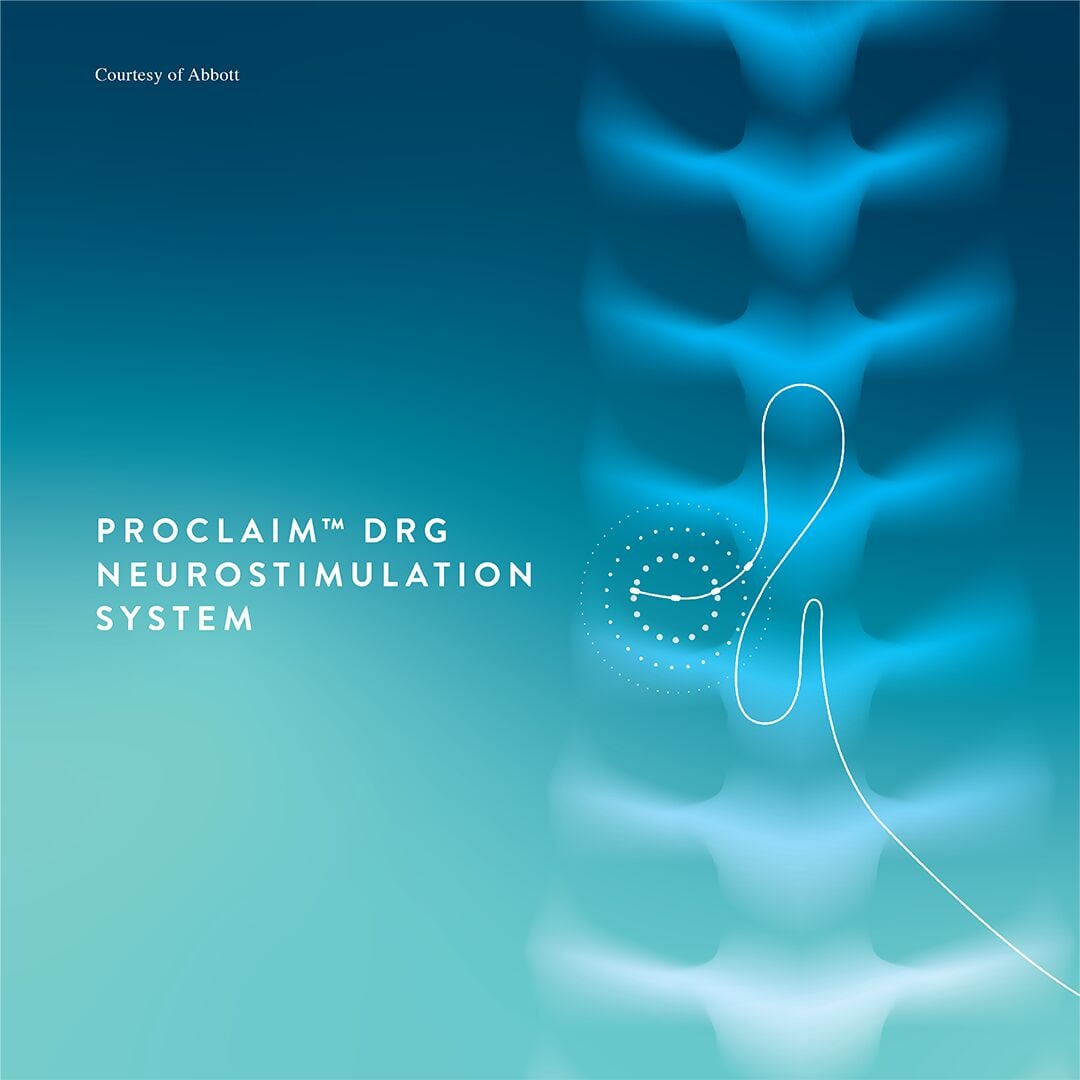
Illustration of an Abbott DRG lead curving around a dorsal root ganglion alongside the vertebral column

At a glance

Signature waveform
BurstDR / FlexBurst360
Power options
Recharge-free and rechargeable
Therapies offered
SCS and DRG stimulation
Patient control
Bluetooth-enabled patient controller app
SCS
DRG
BurstDR stimulation, and one of the two dorsal root ganglion platforms in the U.S.

Two Therapies, Not One

Abbott makes two different things, and the difference matters

Both are neurostimulation, both are made by Abbott, and both are recharge-free — which is exactly why they get confused. But they treat different pain, target different anatomy, and are implanted differently. If you take one thing from this page, take this comparison.

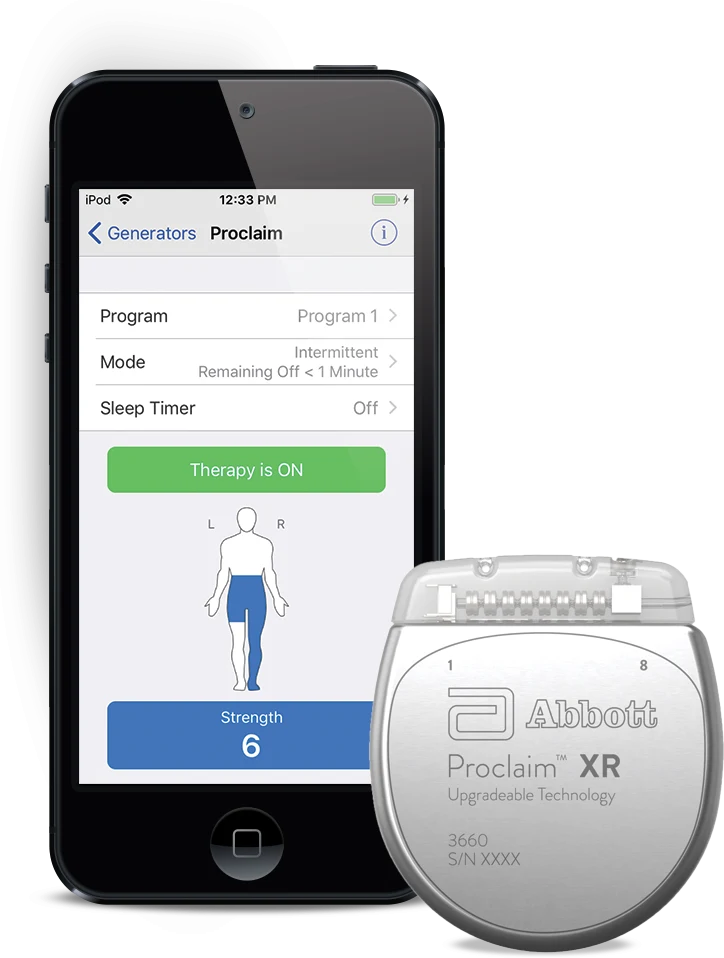
Abbott Proclaim XR spinal cord stimulation generator beside its patient controller showing therapy settings
SCS
The broad-coverage therapy

Spinal Cord Stimulation

Proclaim XR

Where the lead goes
The dorsal columns of the spinal cord
Suits which pain
Diffuse pain across a broad area — most often the low back and both legs after failed spine surgery.

Leads sit in the epidural space over the dorsal columns, where the signals from a whole region of the body converge. Stimulating there modulates that whole stream of traffic before it reaches the brain. BurstDR delivers the energy in closely grouped bursts at a low dose, so most patients feel nothing at all while the therapy is running.

  • Lead sits over the spinal cord itself, covering a broad region
  • Suits widespread pain rather than a single nerve territory
  • BurstDR waveform, dosed intermittently through the BoldXR protocol
  • Recharge-free, with up to 10 years of battery life at the lowest dose setting
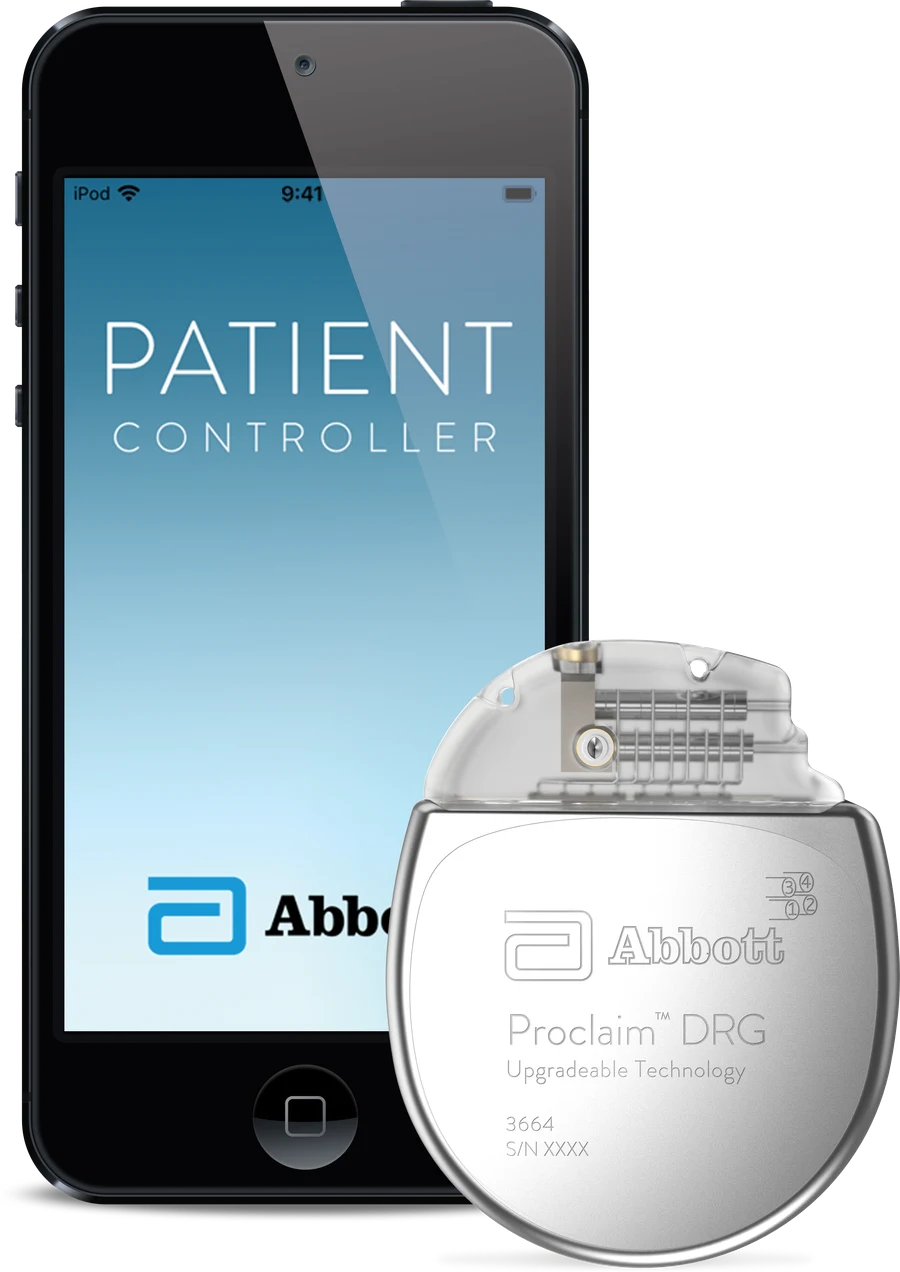
Abbott Proclaim DRG generator beside its patient controller
DRG
The pinpoint therapy

DRG Stimulation

Proclaim DRG

Where the lead goes
A single named dorsal root ganglion
Suits which pain
Focal, stubbornly localised pain in a lower limb. In the United States the approved use is complex regional pain syndrome type I and causalgia of the lower limbs; other focal territories are treated off-label.

The dorsal root ganglion is a small cluster of sensory nerve cell bodies just outside the spinal cord, and each one maps to a defined patch of the body. Placing a lead at a specific ganglion treats that patch and largely leaves the rest alone. It reaches territories the dorsal columns cover poorly, and because the ganglion sits in very little cerebrospinal fluid, it takes far less energy to stimulate.

  • Lead sits at one ganglion, mapping to one defined body territory
  • Reaches territories like the foot and knee that conventional SCS covers poorly
  • Low-energy and paresthesia-free — no tingling sensation
  • A distinct surgical approach with its own technique and its own indication

Product imagery and infographics courtesy of Abbott.

The DRG Case, In Pictures

Why targeting one ganglion is worth the extra difficulty

These four panels come from Abbott's own clinical materials. They are reproduced here because they make the argument for DRG stimulation more clearly than prose does — where the pain comes from, who ends up with it, and what the published outcomes look like.

  • Dermatome mappingEvery ganglion owns a territoryEach dorsal root ganglion from L2 to S1 maps to a defined band of the leg. That map is the whole basis of the therapy: identify which band your pain sits in, and the lead goes to the ganglion that owns it. It is the difference between treating a region and treating an address.
  • Post-surgical painChronic pain after surgery is more common than most people expectPublished prevalence rates for persistent pain after common operations: 15% after total knee replacement, 8.5% after hernia repair, 6% after total hip replacement, and 5.3% after foot and ankle surgery. Much of this pain is focal — confined to the operated territory — which is precisely the pattern DRG stimulation was designed for.Ranges reflect variation across published studies. Reproduced from Abbott clinical materials.
  • Published outcomesResults have held up across 24 studies and nine yearsFinal pain scores from more than twenty published DRG stimulation studies, plotted together. The value is not any single bar — it is that the average final score of 26 stays broadly consistent across very different clinical settings, countries and study designs.Based on final VAS/NRS scores collected from publications using DRG stimulation. Study designs were varied and were not all randomised, controlled multicentre studies.
  • The platformWhat the Proclaim DRG system providesAbbott's own summary of the system: a proprietary delivery mechanism and surgical approach, low-energy paresthesia-free therapy, 6.5-year battery longevity at nominal settings with no recharging, an upgradeable platform, MR conditional labeling, and remote programming through the NeuroSphere Virtual Clinic.Manufacturer claims, reproduced as supplied. Superiority claims compare with traditional tonic SCS based on outcomes from the ACCURATE study; battery figures are within approved parameters. Confirm all specifications against current labeling.

Product imagery and infographics courtesy of Abbott.

The Signature Technology

BurstDR and FlexBurst360

Rather than a continuous train of pulses, BurstDR delivers closely grouped 'bursts' of low-dose energy, designed to modulate pain signaling without producing the tingling sensation (paresthesia) that older tonic stimulation creates. FlexBurst360, introduced with Proclaim Plus, extends that idea by allowing independently programmed stimulation across as many as six areas of the trunk and limbs, so coverage can be adjusted as a patient's pain pattern changes over the years. The BoldXR dosing protocol then delivers that waveform intermittently rather than continuously — the reason a Proclaim generator can run for years without being recharged.

How It Works

From lead placement to therapy delivery

  1. 01

    Thin leads carrying electrode contacts are placed in the epidural space, just outside the spinal cord, and connected to an implanted pulse generator placed under the skin — typically in the upper buttock or flank.

  2. 02

    The generator delivers BurstDR stimulation according to programs set by the physician. Because BurstDR is designed to work below the threshold of sensation, most patients do not feel the stimulation itself.

  3. 03

    Therapy is dosed rather than run continuously — cycled on and off through the day instead of running around the clock. In published six-month data, patients stimulated only one second in every thirteen did as well as those stimulated one second in four, with both groups averaging close to 50% pain reduction. Delivering far less energy for the same result is what makes a recharge-free battery last years.

  4. 04

    Patients adjust their own therapy within limits set by the physician, using a Bluetooth controller on a familiar Apple device rather than a proprietary remote.

  5. 05

    Abbott's DRG therapy follows a different sequence entirely — a different target, a different surgical approach and a different generator. It is compared with the spinal cord stimulation pathway above.

The Platforms

4 systems in the family

Grouped by the therapy each one delivers. Within a group the systems share the same underlying technology and differ in power source, size and intended use; across groups they are different treatments.

Spinal cord stimulation systems

  • Abbott Proclaim Plus recharge-free spinal cord stimulation generator, front view

    Proclaim Plus

    Recharge-free SCS

    A recharge-free implantable pulse generator with FlexBurst360 therapy, approved by the FDA in August 2022.

    • No recharging required by the patient
    • Battery life of up to approximately 10 years, depending on settings
    • Up to six independently programmed stimulation areas
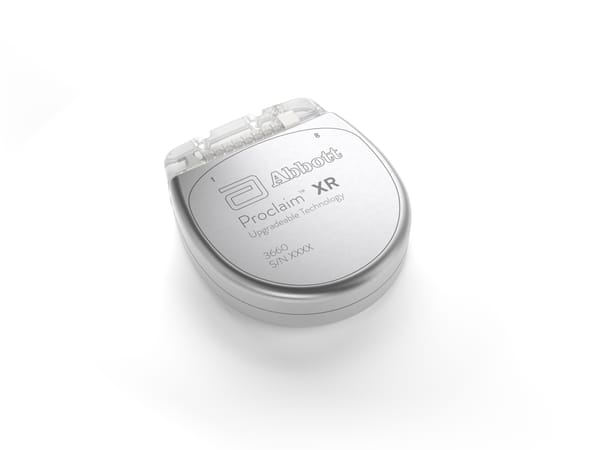
  • Abbott Proclaim XR recharge-free spinal cord stimulation generator, model 3660

    Proclaim XR

    Recharge-free SCS

    The recharge-free workhorse of the range, built around low-dose BurstDR and the BoldXR dosing protocol, which delivers therapy intermittently rather than continuously to extend service life.

    • Recharge-free — up to 10 years of battery life at the lowest dose setting
    • Low-dose BurstDR stimulation, dosed without sacrificing efficacy
    • Full-body MR conditional labeling
    • Bluetooth patient controller on familiar Apple devices
  • Abbott Eterna rechargeable spinal cord stimulation generator, model 3260

    Eterna

    Rechargeable SCS

    Abbott's rechargeable platform, approved in December 2022 and described at launch as the smallest implantable rechargeable SCS system available.

    • Designed to need charging as few as about five times per year
    • Small implant profile
    • Low-dose BurstDR stimulation

DRG stimulation systems

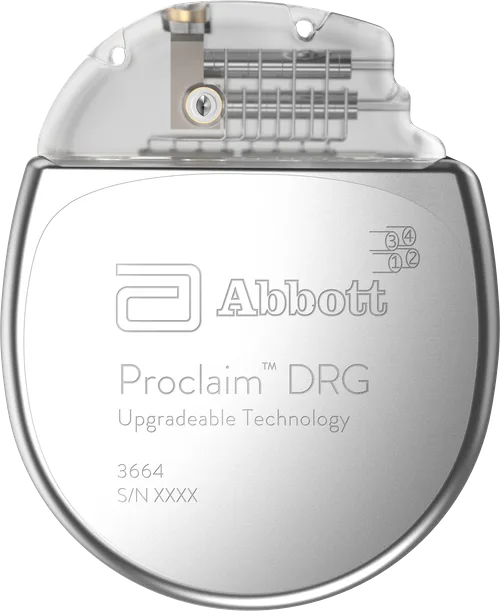
  • Abbott Proclaim DRG neurostimulation generator, model 3664

    Proclaim DRG

    Recharge-free DRG stimulation

    A separate therapy on a separate generator. The lead is placed at a named dorsal root ganglion rather than in the dorsal columns, which is what makes tightly focal territories reachable. Its US approval is specific to CRPS type I and causalgia of the lower limbs.

    • Targets a single named dorsal root ganglion
    • Low-energy, paresthesia-free therapy
    • Recharge-free — 6.5-year battery longevity at nominal settings
    • Remote programming through the NeuroSphere Virtual Clinic

The Evidence

What has been published

Each study is given with its design, who was actually in it, what it found and where it falls short — then a link to the paper itself, so you can check any of it. Most device trials are manufacturer-funded; that is normal in this field and it is labelled here rather than glossed over.

10 of these entries link straight to the published paper on PubMed, where the abstract is free to read. Where a study was funded by the manufacturer or written with its employees, that is labelled on the card rather than left for you to find.

  • ACCURATE — the pivotal DRG trial

    DRG
    Design
    Prospective, multicentre, randomised comparative trial across 22 US sites
    Population
    152 adults with complex regional pain syndrome type I or causalgia (CRPS type II) of the lower limbs, who had already failed at least two drug classes

    What it found

    Treatment success — defined as a permanent implant plus at least 50% pain reduction with no stimulation-related neurological deficit — was reached by 81.2% of the DRG group at three months versus 55.7% of the conventional SCS group, and the advantage held at 12 months. No subject in either arm reported a stimulation-related neurological deficit. This is the trial the FDA indication rests on.

    Limitations

    Unblinded, because the two therapies feel different. The population is narrow — lower-limb CRPS — and the result should not be extrapolated to axial back pain or to other diagnoses. The comparator was conventional tonic SCS, not a modern low-dose or closed-loop system.

    Source

    Deer TR, Levy RM, Kramer J, et al. Dorsal root ganglion stimulation yielded higher treatment success rate for complex regional pain syndrome and causalgia at 3 and 12 months: a randomized comparative trial. Pain. 2017;158(4):669–681.

    Read the full studyPMID 28030470 · doi:10.1097/j.pain.0000000000000814

    Manufacturer-funded or manufacturer-authored

  • ACCURATE sub-analysis — relief without habituation

    DRG
    Design
    Pre-planned sub-study of the ACCURATE randomised trial
    Population
    145 subjects who completed trial stimulation (73 DRG, 72 SCS)

    What it found

    Tested whether the therapies lose effect over the first year. DRG pain relief stayed statistically flat from implant through 12 months, in the 69–74% range. The tonic SCS arm fell significantly, from 66.9% relief at one month to 57.9% at 12 months, with the decline concentrated in CRPS type I. Durability, not just initial response, is the clinically useful distinction here.

    Limitations

    A substudy of an unblinded trial, so it inherits ACCURATE's limitations. Abbott employees are among the named authors. Twelve months is still short relative to how long a patient will live with the implant.

    Source

    Levy RM, Mekhail N, Kramer J, et al. Therapy habituation at 12 months: spinal cord stimulation versus dorsal root ganglion stimulation for complex regional pain syndrome type I and II. J Pain. 2020;21(3–4):399–408.

    Read the full studyPMID 31494275 · doi:10.1016/j.jpain.2019.08.005

    Manufacturer-funded or manufacturer-authored

  • ACCURATE sub-analysis — paresthesia-free therapy

    DRG
    Design
    Retrospective analysis of ACCURATE outcome data
    Population
    61 ACCURATE subjects who received a permanent DRG neurostimulator

    What it found

    The proportion getting pain relief with no tingling at all rose from 16.4% at one month to 38.3% at 12 months, and those patients did as well or better on pain severity, interference, quality of life and mood than patients who did feel stimulation. Higher amplitudes and frequencies, more implanted leads and younger age all made paresthesia more likely.

    Limitations

    Retrospective and unblinded, on a small subgroup. It shows paresthesia is not required for relief; it does not establish that a majority of patients will be paresthesia-free.

    Source

    Mekhail N, Deer TR, Kramer J, et al. Paresthesia-free dorsal root ganglion stimulation: an ACCURATE study sub-analysis. Neuromodulation. 2020;23(2):185–195.

    Read the full studyPMID 30861286 · doi:10.1111/ner.12942

    Manufacturer-funded or manufacturer-authored

  • SUNBURST — the trial behind BurstDR

    SCS
    Design
    Prospective, multicentre, randomised crossover trial
    Population
    100 patients with chronic intractable pain of the trunk and/or limbs, each of whom tried both waveforms

    What it found

    Every patient received the same implant and used tonic stimulation for 12 weeks and burst stimulation for 12 weeks, in randomised order, before choosing which to keep for the remainder of a year. Burst was non-inferior to tonic and then met the superiority threshold, and 70.8% of patients chose burst when given a free choice. This is what supported burst stimulation's US approval.

    Limitations

    Crossover designs carry order effects, and patients could immediately tell the two waveforms apart because one tingles and one does not, so blinding was impossible. Industry-sponsored. Preference is a meaningful endpoint but a softer one than pain reduction.

    Source

    Deer T, Slavin KV, Amirdelfan K, et al. Success Using Neuromodulation With BURST (SUNBURST) study: results from a prospective, randomized controlled trial using a novel burst waveform. Neuromodulation. 2018;21(1):56–66.

    Read the full studyPMID 28961366 · doi:10.1111/ner.12698

    Manufacturer-funded or manufacturer-authored

  • TRIUMPH — two years of real-world burst outcomes

    SCS
    Design
    Prospective, international, multicentre, single-arm post-market study
    Population
    Patients implanted with passive-recharge burst SCS for chronic trunk and limb pain

    What it found

    Follows patients out to 24 months. Pain reduction was statistically significant at every timepoint and patient-reported improvement held steady at 60% throughout. Pain catastrophising scores fell below the general population norm, quality of life improved across all EQ-5D domains, 84% of patients were satisfied at two years and 90% would recommend the procedure. Roughly half reduced opioid intake.

    Limitations

    Single-arm with no control group, so improvement cannot be cleanly separated from natural history, placebo response or regression to the mean. Abbott employees are among the authors. Graded Level 3 evidence by the journal.

    Source

    Deer TR, Falowski SM, Moore GA, et al. Passive recharge burst spinal cord stimulation provides sustainable improvements in pain and psychosocial function: 2-year results from the TRIUMPH study. Spine (Phila Pa 1976). 2022;47(7):548–556.

    Read the full studyPMID 34812195 · doi:10.1097/BRS.0000000000004283

    Manufacturer-funded or manufacturer-authored

  • The dosing evidence behind recharge-free batteries

    SCS
    Design
    Subanalysis pooling two prospective multicentre studies (TRIUMPH and REALITY)
    Population
    195 patients — 100 on a 1:3 duty cycle, 95 on a 1:12 duty cycle — followed six months

    What it found

    This is the study that justifies running BurstDR intermittently rather than continuously, which is the reason a Proclaim generator can last years without recharging. Mean pain intensity fell by nearly half in both groups, pain catastrophising dropped and physical function improved. Crucially, there was no detectable difference between the two duty cycles — patients stimulated one second in thirteen did as well as those stimulated one second in four, with 77% and 80% responders respectively.

    Limitations

    Not randomised to duty cycle — the comparison is between two separate studies, so the groups were not balanced by design. Abbott employees are among the authors. Six months only.

    Source

    Deer T, Wilson D, Schultz D, et al. Ultra-low energy cycled burst spinal cord stimulation yields robust outcomes in pain, function, and affective domains: a subanalysis from two prospective, multicenter, international clinical trials. Neuromodulation. 2022;25(1):137–144.

    Read the full studyPMID 35041583 · doi:10.1111/ner.13507

    Manufacturer-funded or manufacturer-authored

  • Cost-effectiveness against medical management

    DRG
    Design
    Retrospective cost-utility analysis combining ACCURATE data with claims data, modelled over ten years from a US payer perspective
    Population
    Modelled CRPS type I and II cohorts

    What it found

    Both DRG stimulation ($34,695 per quality-adjusted life year) and conventional SCS ($22,084 per QALY) came out cost-effective compared with comprehensive medical management over a ten-year horizon. DRG cost more, largely because more patients converted from trial to permanent implant and because the battery life of the generation studied was shorter.

    Limitations

    A model, not an observation — the output depends entirely on its assumptions, and it uses 2017 dollars. Retrospective. Abbott employees are among the authors. Cost-effectiveness to a payer is not the same question as value to a patient.

    Source

    Mekhail N, Deer TR, Poree L, et al. Cost-effectiveness of dorsal root ganglion stimulation or spinal cord stimulation for complex regional pain syndrome. Neuromodulation. 2021;24(4):708–718.

    Read the full studyPMID 32153073 · doi:10.1111/ner.13134

    Manufacturer-funded or manufacturer-authored

  • Complication rates — the independent numbers

    Safety
    Design
    Systematic review and meta-analysis of proportions, PROSPERO-registered
    Population
    13 studies, 634 patients with DRG stimulation

    What it found

    Independent of any manufacturer, this analysis pooled the non-infectious complications of DRG stimulation. The overall complication rate was 37% (95% CI 19–57%), most of it device-related at 27% (95% CI 15–42%). Lead fracture and lead migration were the most common single problems, at roughly 6% each. Procedure-related complications were rare at about 1%. Most of these are corrected by a revision rather than by abandoning the therapy, but the frequency is worth knowing before consenting.

    Limitations

    Wide confidence intervals reflect real inconsistency between studies in how complications are defined and reported. Much of the underlying data predates current lead designs and delivery systems.

    Source

    Vanloon M, Van Broeckhoven T, Raymaekers V, et al. Noninfectious complications of dorsal root ganglion stimulation: a systematic review and meta-analysis. Neuromodulation. 2025;28(2):234–248.

    Read the full studyPMID 39601733 · doi:10.1016/j.neurom.2024.10.010
  • Infection rates by stage

    Safety
    Design
    Systematic review and pooled incidence analysis
    Population
    Ten studies — 291 trial patients, 250 implanted patients, 26 revisions

    What it found

    The overall DRG infection rate was 2.82% (95% CI 1.62–4.54%). It differed significantly by stage: about 1.03% during the temporary trial, rising to 4.80% after permanent implant and 3.85% at revision. The trial week carries meaningfully less infection risk than the implant itself — which is part of why the trial is worth doing.

    Limitations

    Small pooled numbers, particularly for revisions, where the confidence interval runs from 0.2% to 21.6%. The authors themselves call for better study of prophylaxis. Independent of the manufacturer.

    Source

    Moman RN, Peterson AA, Maher DP, et al. Infectious complications of dorsal root ganglion stimulation: a systematic review and pooled analysis of incidence. Neuromodulation. 2022;25(7):956–964.

    Read the full studyPMID 34096135 · doi:10.1111/ner.13473
  • NACC consensus guidance for DRG stimulation

    Guidance
    Design
    International multidisciplinary consensus, evidence-graded
    Population
    n/a — practice guidance

    What it found

    A 35-page consensus document from the Neuromodulation Appropriateness Consensus Committee covering patient selection, anatomy, implant technique, programming and complication management specific to DRG stimulation. It is the closest thing the field has to a standard of care for this therapy, and it is a reasonable benchmark against which to ask how a given practice does things.

    Limitations

    Consensus reflects expert opinion where trial data is absent, and the panel is drawn substantially from high-volume implanters who are also frequent industry collaborators. Published in 2019, so it predates the more recent labelling changes.

    Source

    Deer TR, Pope JE, Lamer TJ, et al. The Neuromodulation Appropriateness Consensus Committee on best practices for dorsal root ganglion stimulation. Neuromodulation. 2019;22(1):1–35.

    Read the full studyPMID 30246899 · doi:10.1111/ner.12845

These are the studies specific to Abbott. For the trials that shaped the whole field — and for how to read an industry-sponsored study fairly — see the clinical evidence library.

The Trade-offs

What to weigh before choosing this platform

No system is the right answer for every patient. These are considerations to discuss with the clinician who knows your history.

  • Recharge-free systems remove the daily charging burden but are eventually replaced when the battery depletes; rechargeable systems may last longer but require the patient to charge them.

  • DRG stimulation is a distinct therapy with its own indication and its own technical demands — it is not simply 'SCS placed differently'. It asks more of the implanting physician, and it is worth asking how many your surgeon has done.

  • Battery figures quoted by any manufacturer describe specific settings, not a guarantee. Abbott's up-to-10-year figure for Proclaim XR is measured at the lowest dose setting; a patient who needs more energy will see a shorter life.

  • MRI eligibility depends on the specific generator, leads and scan conditions. This must be confirmed against current labeling before any scan.

  • The US approval for DRG stimulation is specifically for CRPS type I and causalgia of the lower limbs. DRG leads are sometimes placed for other focal pain — groin pain, post-surgical knee pain, upper-limb territories — and there is published experience supporting some of it, but in the United States that is off-label use. It is a fair and reasonable question to ask your physician directly whether your proposed use is on- or off-label, and what the evidence for it is.

  • Device-related problems are not rare with DRG stimulation. Independent pooled analyses put the overall non-infectious complication rate around 37%, with lead fracture and lead migration the most common issues, and infection at roughly 4.8% after permanent implant. Most are fixed with a revision rather than by abandoning the therapy, but you should hear these numbers before consenting rather than after.

Regulatory status

Proclaim XR received FDA approval in September 2019, Proclaim Plus with FlexBurst360 in August 2022, and the rechargeable Eterna system in December 2022. The DRG platform's US approval is narrower and more specific than the spinal cord stimulation systems: it is indicated for the management of moderate to severe chronic intractable pain of the lower limbs in adults with complex regional pain syndrome type I or causalgia (CRPS type II) — the population studied in ACCURATE. It reached the US market as the Axium system in 2016 and carried forward onto the Proclaim generator. In January 2024 the FDA approved expanded labeling allowing full-body MRI scans with the Proclaim DRG system implanted.

Indications, contraindications, warnings and MRI conditions are defined by the current labeling. Review the manufacturer's Instructions for Use at neuromodulation.abbott and discuss them with your physician.

Wondering whether this therapy fits your situation?

Explore how candidacy is assessed, then discuss your pain pattern, imaging and prior treatments with a clinician. Device selection comes later.