
Restorative neurostimulation
Mainstay Medical
ReActiv8 is deliberately different from spinal cord stimulation and should not be described as a type of it. Its intended primary mechanism is motor activation of the lumbar multifidus rather than modulation of pain signaling in the spinal cord. In appropriately selected adults with mechanical chronic low back pain and multifidus dysfunction, repeated stimulation is designed to help recover neuromuscular control and segmental stability.

Restorative neurostimulation
Designed to activate the lumbar multifidus
At a glance
- Therapy type
- Restorative neurostimulation
- Target
- Bilateral L2 medial branch → lumbar multifidus
- Use pattern
- Typically two 30-minute sessions daily
- FDA approval
- PMA P190021 · June 16, 2020
A therapy designed to activate the multifidus and facilitate recovery of neuromuscular control.
The Anatomy Behind The Therapy
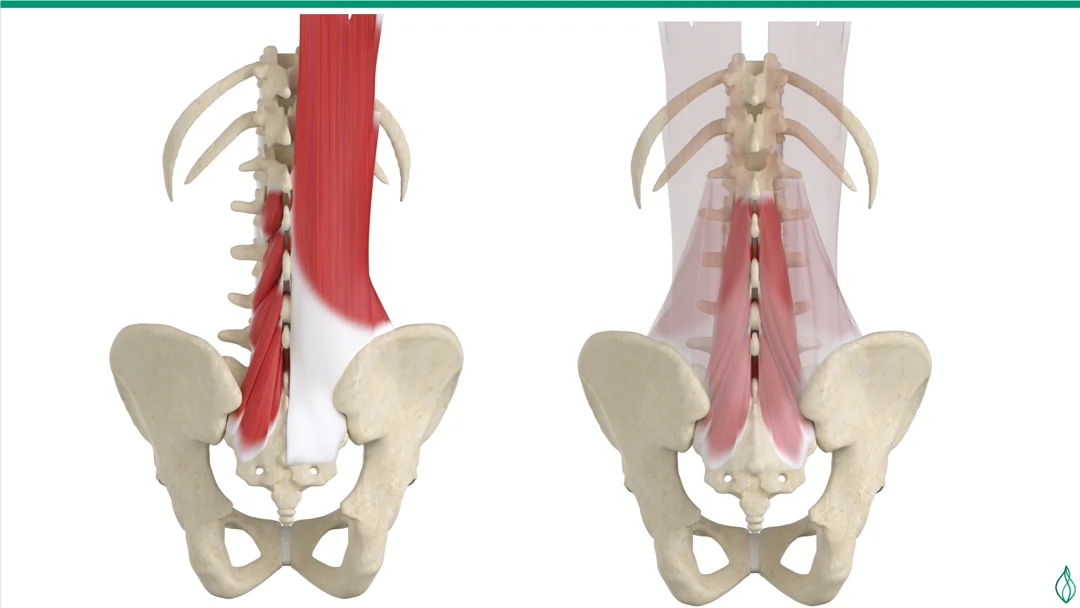
The multifidus is small, deep and essential
Running close to the spine, the lumbar multifidus helps control movement between individual vertebrae. When neuromuscular control is impaired, the larger back muscles may compensate without restoring the same segmental stability.
ReActiv8 is designed primarily to activate the multifidus through its motor nerve supply — not to stimulate the dorsal columns of the spinal cord.
That distinction is why this treatment sits in its own category. It is restorative neurostimulation, not spinal cord stimulation.
Patient Selection
A specific therapy for a specific pattern
ReActiv8 is not a general-purpose treatment for every kind of back pain. The diagnosis and the reason the multifidus is suspected both matter.
Pain pattern
Predominantly mechanical low back pain
The pain is centred in the lower back and behaves like a mechanical problem rather than a primarily nerve-root or leg-pain syndrome.
Clinical evidence
A finding consistent with multifidus dysfunction
Selection depends on a clinical examination and supporting imaging or physiological testing interpreted in the context of the whole patient.
Treatment course
A restorative process measured over time
The system is used in scheduled sessions. The aim is progressive improvement in motor control and function, not moment-to-moment masking of pain.
The Treatment Rhythm
Short sessions. A long restorative arc.
A commonly prescribed routine is two 30-minute sessions each day. During each session, stimulation activates the multifidus in repeated contractions.
The exact program and schedule are set by the treating team. Because the goal is restoration rather than immediate pain masking, progress is assessed across function, activity and symptoms over time.
Supplied by Mainstay
Directly from Mainstay Medical
The links, videos and approved excerpts in this box were provided by Mainstay and are published with the company's written authorisation. Quoted copy is kept separate from our editorial descriptions.
Neuromuscular control, proprioception and back muscles
This player is provided by Vimeo. Loading it connects your browser to Vimeo under that provider's privacy terms.
Multifidus dysfunction and loss of neuromuscular control
This player is provided by Vimeo. Loading it connects your browser to Vimeo under that provider's privacy terms.
Restorative and palliative treatment approaches
This player is provided by Vimeo. Loading it connects your browser to Vimeo under that provider's privacy terms.
A patient introduction to ReActiv8
This player is provided by Vimeo. Loading it connects your browser to Vimeo under that provider's privacy terms.
Approved excerpts from Mainstay Medical
ReActiv8 restorative neurostimulation is designed to address the underlying cause of mechanical low back pain by helping patients restore neuromuscular control of the multifidus muscle. Re-establishing this control relieves the other muscles in the back (erector spinae) from compensating for the absence of support from the multifidus.
ReActiv8 involves a minimally invasive outpatient implantation procedure - leads are placed next to nerves outside of the spinal canal and connected to an implanted pulse generator. The patient then controls the stimulation therapy with a handheld remote during two 30-minute sessions per day, which allows the system to contract and relax the multifidus muscle via the stimulation of the medial branch nerve.
— Mainstay Medical, approved patient information
Mainstay Medical supplied this practice with its ReActiv8 website marketing kit and written permission to use the included language, videos and anatomical imagery. Material in this section is identified as manufacturer-provided; Mainstay Medical did not pay for inclusion and has no editorial control over the rest of this page.
Multifidus Anatomy
The stabilising muscles ReActiv8 is designed to activate
These manufacturer-supplied anatomical views show how deeply the multifidus sits beside the lumbar spine. They are educational illustrations, not a diagnostic test or a depiction of an individual patient's imaging.
Axial viewDeep muscles surround the posterior spineIn cross-section, the multifidus lies close to the spinous process and facet region. Its position allows it to influence control at individual lumbar segments rather than simply producing large trunk movements. Oblique viewThe multifidus spans adjacent vertebral levelsSeen from the side, short bundles of multifidus bridge neighbouring lumbar levels beneath the larger superficial back muscles. ReActiv8 stimulates the medial branch nerve that supplies this muscle.
Anatomical imagery and ReActiv8 artwork courtesy of Mainstay Medical.
The Signature Technology
Restorative rather than pain-signal modulation
Multifidus dysfunction is associated with impaired neuromuscular control and may contribute to a cycle of reduced segmental stability, pain and further deconditioning. ReActiv8 stimulates the L2 medial branch of the dorsal ramus to produce episodic multifidus contractions, with the aim of overcoming inhibition and facilitating recovery of control over time. Patients typically use scheduled sessions rather than continuous stimulation, and the therapy is not intended to produce immediate pain masking while it is running.
How It Works
From lead placement to therapy delivery
- 01
Two leads are placed to stimulate the L2 medial branch of the dorsal ramus bilaterally where it crosses the L3 transverse process, then connected to an implanted pulse generator.
- 02
The patient initiates prescribed sessions — typically two 30-minute sessions daily — while positioned as instructed. Programming can vary within the system's labeled limits.
- 03
Stimulation recruits motor fibres supplying the lumbar multifidus and produces repeated contractions. The intended therapeutic model is progressive recovery of neuromuscular control and function rather than immediate analgesia.
The Platforms
The system
Each system in this family is built on the same underlying technology, but they differ in power source, size and intended use.
ReActiv8
Restorative neurostimulation
An implantable restorative neurostimulation system for intractable chronic low back pain associated with multifidus dysfunction.
- Designed to recruit the lumbar multifidus through its motor nerve supply
- Scheduled sessions rather than continuous stimulation
- MR Conditional only for qualifying system configurations and scan conditions
The Evidence
What has been published
Each study is given with its design, who was actually in it, what it found and where it falls short — then a link to the paper itself, so you can check any of it. Most device trials are manufacturer-funded; that is normal in this field and it is labelled here rather than glossed over.
3 of these entries link straight to the published paper on PubMed, where the abstract is free to read. Where a study was funded by the manufacturer or written with its employees, that is labelled on the card rather than left for you to find.
ReActiv8-B — the 120-day sham-controlled phase
- Design
- International, prospective, double-blind, randomised active-sham trial at 26 centres
- Population
- 204 implanted adults with highly selected refractory mechanical, non-neuropathic low back pain and evidence of multifidus dysfunction
What it found
The prespecified primary endpoint — at least 30% pain reduction without increased analgesics at 120 days — was reached by 57.1% with therapeutic stimulation and 46.6% with sham. The 10.4-point difference was not statistically significant (95% CI −3.3 to 24.1; p=0.138), so the primary superiority endpoint was not met. Mean changes in pain, disability and quality of life favoured treatment, but these secondary findings are supportive rather than confirmatory after a failed primary endpoint.
Limitations
After 120 days every remaining sham participant elected therapeutic stimulation, so there was no long-term randomised control. The population was narrowly selected, and Mainstay Medical funded and participated in the study.
Source
Gilligan C, Volschenk W, Russo M, et al. An implantable restorative-neurostimulator for refractory mechanical chronic low back pain: a randomized sham-controlled clinical trial. Pain. 2021;162(10):2486–2498.
Read the full studyPMID 34534176 · doi:10.1097/j.pain.0000000000002258Manufacturer-funded or manufacturer-authored
ReActiv8-B — two-year follow-up
- Design
- Open-label continuation after crossover of the sham group
- Population
- 156 of the original 204 implanted participants with two-year completed-case data
What it found
Among participants with two-year data, 71% reported at least 50% pain reduction, 61% improved by at least 20 ODI points, and 60% of the 57 baseline opioid users with available data had voluntarily reduced or stopped opioids.
Limitations
There was no concurrent control after month four, roughly one quarter of the original cohort lacked two-year completed-case data, outcomes were patient-reported, and the study was manufacturer-funded.
Source
Gilligan C, Volschenk W, Russo M, et al. Long-term outcomes of restorative neurostimulation in patients with refractory chronic low back pain secondary to multifidus dysfunction: two-year results of the ReActiv8-B pivotal trial. Neuromodulation. 2023;26(1):87–97.
Read the full studyPMID 35088722 · doi:10.1016/j.neurom.2021.10.011Manufacturer-funded or manufacturer-authored
ReActiv8-B — five-year follow-up
- Design
- Prospective longitudinal follow-up of the implanted pivotal-trial cohort
- Population
- 126 of the original 204 participants with five-year data
What it found
Among five-year completers, mean pain VAS improved from 7.3 to 2.4 cm, 71.8% reported at least 50% pain reduction, and mean ODI improved from 39.1 to 16.5. Model-based estimates accounting for missing data were less favourable — VAS 3.3 and ODI 20.3 — but still reflected substantial average improvement.
Limitations
Only 62% of the implanted cohort supplied five-year data, there was no control group after the early crossover, device removals may contribute survivor bias, and the study was manufacturer-funded.
Source
Gilligan C, Volschenk W, Russo M, et al. Five-year longitudinal follow-up of restorative neurostimulation shows durability of effectiveness in patients with refractory chronic low back pain associated with multifidus muscle dysfunction. Neuromodulation. 2024;27(5):930–943.
Read the full studyPMID 38483366 · doi:10.1016/j.neurom.2024.01.006Manufacturer-funded or manufacturer-authored
These are the studies specific to Mainstay. For the trials that shaped the whole field — and for how to read an industry-sponsored study fairly — see the clinical evidence library.
The Trade-offs
What to weigh before choosing this platform
No system is the right answer for every patient. These are considerations to discuss with the clinician who knows your history.
The FDA indication is specific: intractable chronic low back pain associated with multifidus dysfunction evidenced by imaging or physiological testing, in adults who have failed therapy including pain medication and physical therapy and who are not candidates for spine surgery.
The treatment is designed around gradual recovery rather than immediate pain masking. Expectations, adherence to the prescribed sessions and the way progress will be measured should be discussed before implantation.
Implant-related risks include pain at the generator pocket, infection, bleeding, nerve irritation or injury, uncomfortable stimulation, lead or device problems, and the possibility of revision or explant surgery.
In the FDA-approved five-year clinical summary, 42% of the original trial cohort underwent some additional ReActiv8 surgical intervention and 31% underwent system explant. Reasons included inadequate effectiveness, symptom improvement or resolution, historical MRI needs before MR Conditional labeling, and infection.
MRI access is conditional, not universal. Current U.S. labeling permits specified full-body 1.5T scans only for qualifying Model 5100 systems with two connected 45 cm Model 8145 leads and under the manufacturer's detailed scan conditions.
Regulatory status
FDA PMA P190021 was approved June 16, 2020 for bilateral stimulation of the L2 medial branch of the dorsal ramus as it crosses the L3 transverse process, as an aid in managing intractable chronic low back pain associated with multifidus dysfunction in appropriately selected adults. MR Conditional labeling was first approved in January 2024 and applies only to qualifying system configurations and specified 1.5T scan conditions.
Indications, contraindications, warnings and MRI conditions are defined by the current labeling. Review the manufacturer's Instructions for Use at mainstaymedical.com and discuss them with your physician.
Wondering whether this therapy fits your situation?
Explore how candidacy is assessed, then discuss your pain pattern, imaging and prior treatments with a clinician. Device selection comes later.